Qushenghuo Tech · Architecture & Delivery
E-Commerce & Supply Chain SaaS Platform
Five roles · Multi-party orders · Open supply-chain APIs
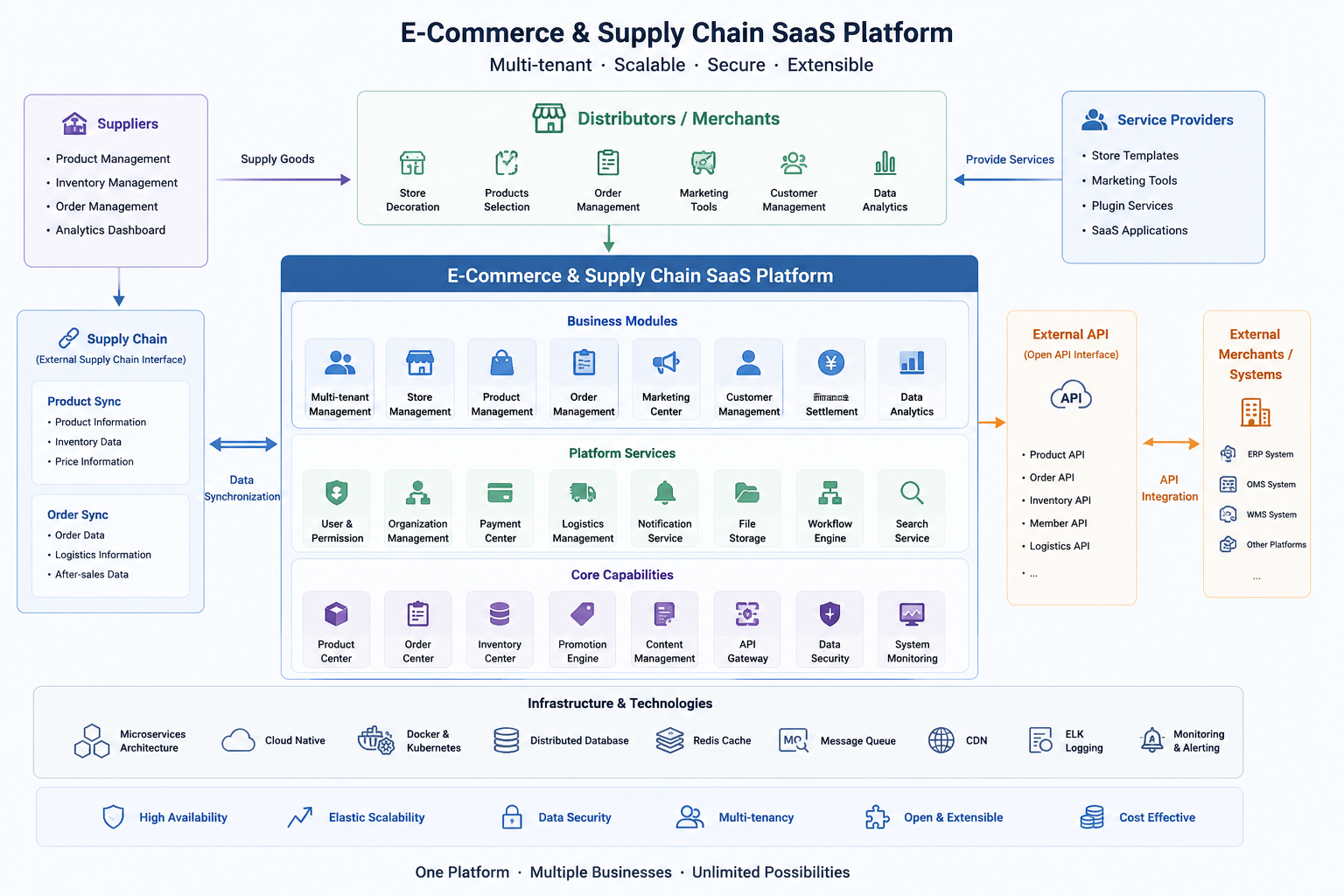
A large-scale multi-tenant supply chain SaaS platform inspired by Youzan and the Taobao Service Marketplace. It puts five business roles on one system: suppliers, distributors, service providers, platform administrators, and third-party enterprise partners. Suppliers onboard products; distributors sell both their own goods and supplier goods; service providers develop storefront themes, plugins, and operational tools that distributors can purchase. External supply-chain providers plug in alongside open APIs for third-party businesses to sync products, place orders, and manage fulfillment. The core of the software is order management: a single customer order can span multiple suppliers, distributors, external supply chains, and enterprise systems, with one coordinated lifecycle for fulfillment, settlement, and returns.
What This Platform Delivered
Five Roles on One Platform
Suppliers, distributors, service providers, platform admins, and third-party enterprise partners share one multi-tenant stack with isolated data and operations.
Supplier Catalogs, Distributor Stores
Suppliers onboard products to the platform. Distributors sell both their own goods and supplier goods from customizable storefronts.
Service Marketplace, Not Just Apps
Service providers develop storefront themes, plugins, and operational tools that distributors can purchase and use — similar to the Taobao Service Marketplace.
External Supply Chains in the Loop
The platform integrates multiple external supply-chain providers and exposes APIs so third-party businesses can sync products, place orders, and manage fulfillment.
Orders That Span Many Parties
A single customer order can involve several suppliers, distributors, external supply chains, and enterprise systems — lifecycle, fulfillment, settlement, and returns were designed as distributed workflows.
Enterprise Delivery Stack
Spring Cloud, clustered data stores, and containerized delivery so tenancy, trading, and partner APIs can scale together.
Roles & Core Systems
Five roles · Multi-party orders · Open supply-chain APIs
Suppliers
Onboard products to the shared catalog for distributors and partner channels to sell.
- ▸Supplier onboarding
- ▸Product publishing
- ▸Inventory sync
- ▸Split-order fulfillment
Distributors
Run stores that sell own products and supplier products, with purchased themes and tools.
- ▸Own + supplier catalogs
- ▸Store customization
- ▸Theme / plugin purchase
- ▸Downstream sales
Service Providers
Build and sell storefront themes, plugins, and operational tools in a marketplace.
- ▸Themes & plugins
- ▸Operational tools
- ▸Listing & purchase
- ▸Provider settlement
Platform Administrators
SaaS control plane for tenants, roles, marketplace governance, and risk.
- ▸Tenant provisioning
- ▸Role & permission model
- ▸Marketplace review
- ▸Platform billing / ops
Third-party Enterprise Partners
APIs to sync products, place orders, and manage fulfillment from external systems.
- ▸Product sync APIs
- ▸Order placement APIs
- ▸Fulfillment status
- ▸Gateway, keys & scopes
Order & Settlement Core
The most complex layer: one order, many parties, one consistent lifecycle.
- ▸Order lifecycle
- ▸Multi-party fulfillment
- ▸Settlement across roles
- ▸Return workflow
Typical Flows
Supplier Onboards, Distributor Sells
A supplier publishes products; a distributor lists both own SKUs and supplier SKUs in a themed storefront and sells to end customers.
Distributor Buys a Theme or Plugin
A service provider lists a theme, plugin, or ops tool; the distributor purchases it from the marketplace and applies it to the store — then provider fees settle on the platform.
One Order, Many Fulfillment Parties
A customer checkout spans items from several suppliers and the distributor’s own stock, plus an external supply-chain line. The order is split, routed, fulfilled, and later settled independently per party.
External Supply Chain in the Order
An integrated supply-chain provider receives its slice of the order via API, ships, and posts fulfillment status back without owning the customer-facing store.
Third-party Enterprise Sync
A partner ERP or brand system syncs products, places orders, and manages fulfillment through open APIs under gateway policies.
Return Across the Graph
A return must unwind the original split: reverse logistics, restock or reject per supplier/chain, and reverse settlement across distributors and partners.
Capability Overview
| Domain | Capabilities |
|---|---|
| Roles | Suppliers, distributors, service providers, platform admins, third-party enterprise partners |
| Catalog & stores | Supplier onboarding, distributor own + supplier goods, storefront themes |
| Marketplace | Service-provider themes, plugins, operational tools, purchase and settlement |
| Orders | Multi-party order lifecycle, split fulfillment, settlement, return workflow |
| Integrations | External supply-chain providers; APIs for product sync, order placement, fulfillment |
| Delivery | Java / Spring Cloud, Redis, MySQL, Vue.js, Docker, K8s |
Tech Stack
This is not a simple multi-store mall. Five roles, external supply chains, and partner APIs meet in one order graph — lifecycle, fulfillment, settlement, and returns stay consistent under distributed execution. That order workflow is the architectural core of the platform.